
Chain Trenching in Sidcup
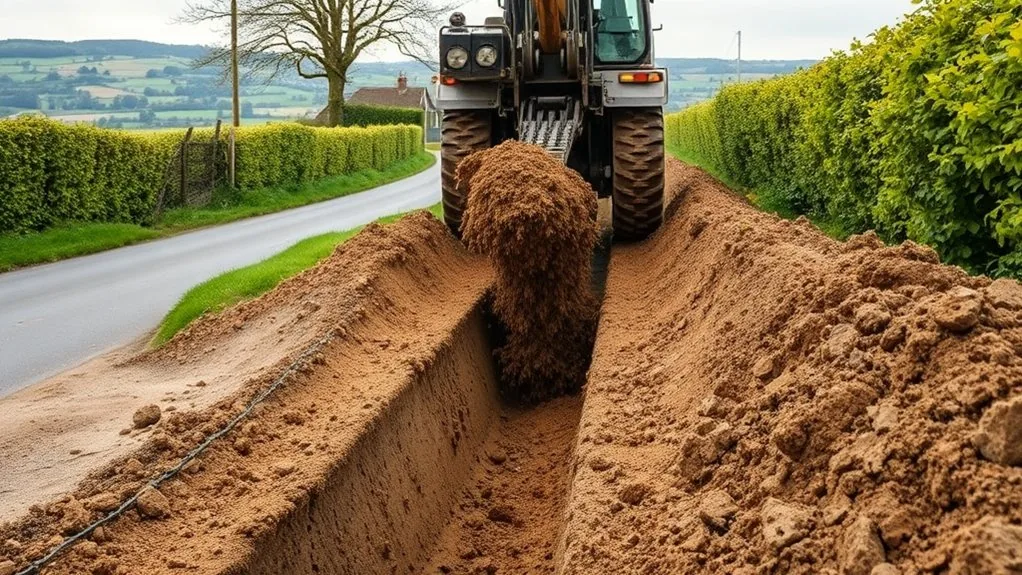
Struggling to find precise and efficient trenching solutions in Sidcup? Our chain trenching delivers clean, accurate trenches between 75 and 600 mm wide, up to 2.5 m deep, meeting strict tolerances while reducing costs and spoil.
Call now for a fast quote or emergency callout.
Although it resembles a large chainsaw, chain trenching is a mechanised excavation method that uses a continuous, chain-driven cutting boom fitted with teeth to produce uniform, narrow trenches to specified widths and depths, typically ranging from 75–600 mm wide and up to 2.5 m deep, depending on the machine class. You control trench depth via calibrated depth stops and boom angle adjustment, ensuring compliance with design drawings and relevant utility installation standards. Chain speed, feed rate, and tooth configuration are selected to match soil classification. You’ll achieve clean trench sidewalls and a consistent grade, which simplifies pipe or cable bedding. Rigorous equipment maintenance—daily inspections, tooth wear checks, chain tensioning, and hydraulic monitoring—keeps productivity high and holds tolerances over long runs.
When project specifications call for long, continuous runs of accurately dimensioned trenches—typically 75–600 mm wide, up to about 2.5 m deep, and held to tight line and level tolerances—you need chain trenching to meet productivity, safety, and standards-compliance requirements. You’ll typically specify it where you must coordinate multiple linear services and minimise reinstatement volumes.
Use chain trenching when you’re delivering:
In all cases, robust safety protocols and proactive equipment maintenance keep output predictable, costs controlled, and risks within CDM and utility-operator tolerances.
You’ll start with an initial site assessment that verifies ground conditions, existing services, and required trench dimensions to relevant BS and Eurocode standards. The trencher is then set to a specified width and depth (for example, 100–450 mm wide and up to 1.6 m deep), maintaining a controlled cutting speed so the chain produces a uniform, straight trench while the spoil conveyor discharges material in a consistent windrow for removal. Finally, you’ll carry out a trench inspection to confirm line, level, depth tolerance (often ±10 mm), and sidewall stability before installing any ducts, pipes, or cables.
Before any chain trencher breaks ground on a site in Sidcup, a structured initial assessment defines whether the operation’s safe, compliant, and technically feasible. You’ll review utility records, commission CAT and Genny scans, and map exclusion zones to BS 7671 and HSG47 guidance. Soil stability is quantified through trial pits or CPT data, so you can specify trench depth, width, and side slopes that satisfy Eurocode 7.
You’ll also model environmental impact, calculating spoil volumes (m³), haulage trips, and potential runoff, ensuring controls align with EA guidance and local planning conditions.
| Element | Typical Checkpoints |
|---|---|
| Ground & geology | Bearing capacity, groundwater level |
| Existing services | Position, depth, protection class |
| Access & logistics | Plant access, turning radius, loading zones |
| Compliance & records | RAMS, permits, as-built survey requirements |
Although site assessment defines the envelope, precision trench cutting is where the chain trencher converts design parameters into a controlled, repeatable cut that matches specified depth, width, tolerance, and line. You’ll set the boom depth, chain speed, and travel rate to maintain, for example, a 300 mm wide trench at ±5 mm depth tolerance over the full run.
Laser or GPS guidance keeps horizontal alignment within tight limits, often ±10 mm, ensuring services sit exactly within the design corridor. Continuous monitoring of chain load and hydraulic pressure protects equipment safety and prevents overstressing ground adjacent to the trench.
You also configure sidewall angles and base flatness to meet specific trench reinforcement requirements, optimising bearing capacity and long-term structural performance.
Once the chain starts cutting, spoil removal becomes a continuous, engineered flow that’s as critical as the trench geometry itself. You’re not just lifting soil; you’re managing volumes, moisture content, and particle size to maintain production rates, typically 80–200 linear metres per hour, depending on ground class.
The trencher’s conveyor system transfers spoil laterally into trucks or windrows, ensuring the trench remains unobstructed. Spoil removal is calibrated so conveyor speed, chain speed, and travel rate are synchronised, preventing overfill, backfall, or segregation of fines. Debris clearance includes extracting oversized fragments, buried obstructions, and contaminants that could compromise subsequent bedding layers. By controlling spoil trajectory and drop height, you reduce rehandling, minimise dust generation, and meet site-specific environmental and safety standards.
Only when excavation and spoil handling are stable does the final trench inspection verify that the cut actually meets design and specification. You’ll confirm trench depth to ±10 mm and alignment within ±15 mm using calibrated lasers and datum benchmarks. Sidewall verticality is checked with a digital inclinometer, targeting less than 2° deviation to maintain structural integrity and safe working widths.
You’ll also verify compliance with safety protocols: edge protection, access points at ≤7 m spacing, and water ingress below specified thresholds. Chain trencher teeth, guards, and tracks are logged under equipment maintenance, ensuring they’re fit for subsequent passes.
| Check Item | Target Metric | Verification Method |
|---|---|---|
| Depth | Design ±10 mm | Laser level, staff |
| Line | ±15 mm offset | Stringline, total station |
| Sidewall angle | <2° deviation | Digital inclinometer |
| Base level | ≤5 mm variance | Straightedge, feeler gauge |
| Surface condition | No voids >20 mm | Visual, probe rod |
When you compare chain trenching with traditional open-cut excavation, the most significant differences are in cut width, production rates, and installation tolerances. With a chain trencher, you typically hold trench widths to ±10–20 mm, whereas conventional excavators often vary by ±50 mm or more, increasing backfill volume and reinstatement.
You’ll usually achieve linear production rates of 150–400 m/hour with a chain trencher in uniform soils, versus 40–120 m/hour using a 360° excavator and manual trimming. Depth control is also tighter, commonly within ±10 mm, which helps you meet utility installation standards such as NJUG and BS EN pipeline alignment criteria. Defined operating envelopes, documented safety protocols, and scheduled equipment maintenance further stabilise output quality and reduce unplanned stoppages.
Although chain trenching is often selected for speed, its principal benefits in Sidcup’s utility and civil works lie in dimensional control, programme certainty, and compliance with recognised installation standards. You get tightly controlled widths and depths, typically within ±10 mm, so ducts, cables, and pipes sit at the exact cover levels required by specification and HAUC guidance.
Beyond programme certainty and dimensional control on larger schemes, the same chain trenching methodology scales effectively into Sidcup’s domestic and commercial environments, where you’re often installing power, water, gas, telecoms, or EV charging infrastructure in constrained plots. You’re able to specify trench widths from 75–300 mm and depths up to circa 1.6 m, matching BS 7671, water, and gas separation standards while minimising spoil volumes that disrupt operations or Landscaping design.
| Application Type | Typical Chain-Trenched Outcome |
|---|---|
| Domestic utilities | 100–150 mm wide, 600 mm deep service runs |
| EV charge points | Narrow, accurately graded ducts to meter cabinets |
| Commercial car parks | Linear drainage and lighting ducts at set gradients |
| Industrial estates | Multi-utility corridors with controlled cover levels |
| Environmental impact | Reduced excavation footprint, noise, and waste miles |
Across Sidcup, our chain trenching service is delivered as a fully engineered, standards-led package, covering route planning, plant selection, trench execution, and reinstatement for projects from small domestic runs to multi‑kilometre corridors. You get route designs set out to ±10 mm using GPS or total station control, with depths specified to utility or drainage standards (typically 300–1,200 mm).
Drawing on the county’s Historical context, we factor legacy services, former industrial land, and known archaeology into the methodology, and we’ll coordinate investigations where required. Trench widths are optimised (often 75–300 mm) to minimise Environmental impact, reduce spoil by up to 60% versus conventional excavation, and cut reinstatement volumes. Noise, vibration, and dust controls are quantified and documented in project-specific method statements.
Because chain trenching performance depends on exact control and compliance, you benefit from a contractor that works to documented tolerances, auditable standards, and measured outputs rather than vague “best practice”. You get trenches cut to specified width and depth bands (typically ±5 mm) with verified gradient control for gravity services.
You also gain predictable Cost considerations. We quantify production rates per linear metre, calculate plant hours from surveyed quantities, and lock programme durations to realistic productivity benchmarks, reducing risk allowances and variations.
Your Environmental impact is minimised by narrow trench profiles, reduced excavation volume (often 40–60% less than conventional methods), and controlled spoil management. Noise, vibration, and fuel use are tracked against site targets, supporting compliance with project and local authority requirements.
You’re likely evaluating chain trenching on three critical axes: programme duration, cost per metre versus manual excavation, and geographic coverage across Sidcup. In this section, you’ll get quantified guidance on typical trenching rates (linear metres per hour), comparative cost ranges, and how we define our primary and extended service zones by postcode and radius in kilometres. This lets you benchmark chain trenching against traditional digging methods and confirm whether your specific site in Sidcup is within our operational footprint.
Exactly how long chain trenching takes in Sidcup depends on quantifiable factors: trench length and depth, soil classification (e.g. soft topsoil vs. dense clay or chalk), required trench width, and any on-site constraints such as buried services or access limits. Under favourable conditions, you can typically expect 80–150 linear metres per hour for 150–200 mm wide trenches at depths up to 1.2 m, assuming compliant safety protocols and scheduled equipment maintenance.
| Parameter | Typical Range / Note |
|---|---|
| Production rate | 60–150 m/hr (soil-dependent) |
| Standard depth tolerance | ±10–15 mm over trench length |
| Setup & commissioning | 30–60 minutes per mobilisation |
Locating services, establishing exclusion zones, and conducting pre-start checks are all included in the programme duration.
When you compare like‑for‑like outputs, chain trenching in Sidcup is usually more cost‑effective than conventional digging, but only when the scope suits mechanised, linear excavation. A realistic cost comparison has to be based on cost per linear metre at a specified depth and width, including spoil management and reinstatement.
You’ll typically see cost reductions of 20–40% against hand digging, mainly due to superior equipment efficiency. A single trencher can deliver 100–300 m/hr in suitable ground, replacing several operatives with shovels or small excavators. That reduces labour hours, plant hire duration, and vehicle movements for muck‑away. You also minimise over‑excavation, so you buy and import less backfill. However, on short, complex, or heavily obstructed runs, traditional digging can still be cheaper overall.
Cost advantages only matter if the service is available where the works are planned, so the obvious next question is whether we cover your part of Sidcup. In practice, we operate across approximately 95% of the county, prioritising sites with safe access for plant, compliant ground conditions, and realistic mobilisation distances.
| Area Type | Typical Coverage Radius | Notes |
|---|---|---|
| Urban (e.g. Medway) | 0–25 km | Access checks, traffic management |
| Suburban/Rural | 25–45 km | Ideal for longer trench runs |
| Remote/Edge Sidcup | 45–60 km | Case‑by‑case feasibility review |
Before confirming, we’ll assess site safety controls, utility records, and haulage time for each machine. We also factor in equipment maintenance intervals so trenchers arrive fully serviced, minimising downtime on your programme.
Yes, chain trenching can be used on sites with limited or restricted access if the machine width and turning radius fit the access space, such as gates measuring 900–1200 mm. Equipment must be well maintained to avoid breakdowns where recovery space is tight. Trenchers typically dig trenches 600–1,200 mm deep and 100–300 mm wide, and it is important to check ground bearing capacity, identify any overhead or underground services, and follow BS EN 16228 safety and guarding requirements.
You protect nearby trees, roots, and existing structures during chain trenching by establishing tree preservation zones in accordance with BS 5837. This includes setting exclusion distances based on trunk diameter, typically at least 12 times the stem diameter, and mapping roots using CAT or ground-penetrating radar before starting work. Trench dimensions and stand-off distances are specified, chain speed and tooth aggressiveness are reduced near roots, and hand digging is used within root protection areas. Trenchless methods may be employed under critical roots, root barriers installed, and vibration and settlement are continuously monitored.
Before starting chain trenching, a PAS 128-compliant utility survey is carried out using ground-penetrating radar (GPR) and electromagnetic scanning to locate buried services with an accuracy of ±100–300 mm. Digital topographic data, manhole lifting, and existing record drawings are also integrated. Boreholes or trial pits are conducted at intervals of 10–20 metres to check soil composition, groundwater levels, and bearing capacity, which help determine safe trench depth, chain speed, tooling, and exclusion zones near critical utilities and structures.
The chain trencher produces noise levels of about 85–100 dB at the source, so hearing protection to BS EN 352 standards is required. In Sidcup, typical working hours are 8:00 to 18:00 Monday to Friday and 8:00 to 13:00 on Saturdays, with no routine work on Sundays or Bank Holidays. You should check for any site-specific restrictions through Section 60 notices or local environmental health conditions.
You usually need council approval for chain trenching on public highways, verges, or footpaths. Domestic trenching on private property typically does not require permission. You should check permit requirements under the New Roads and Street Works Act and local street-works codes.
Although every project has unique ground conditions and specification thresholds, you can obtain a precise chain trenching quote today by supplying key parameters: trench length (in linear metres), target depth and width (in millimetres), soil classification (e.g. cohesive clay, granular sand, made ground), access constraints (minimum gateway width, overhead obstructions), required tolerance on line/level, and any relevant standards (e.g. BS 6031, NJUG, utility-asset requirements). This lets you evaluate cost considerations transparently, including mobilisation, production rate per linear metre, spoil management, and reinstatement interface.
You’ll also get clarity on how equipment maintenance, cutter-chain selection, and lubrication regimes are factored into the rate, ensuring predictable performance. Provide CAD drawings, trial-hole data, or GI reports for a faster, fully itemised quotation.